


An interesting publication by Davide Gangale Risoleo: Distributing Water at Aquinum: Some Reflections on the Lead Pipes
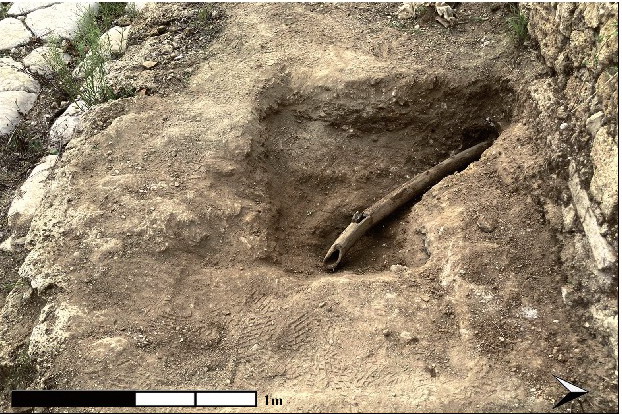
The fistula discovered in 2022 near the theatre, located within the pavement (photo by the author)
Our member Davide Gangale Risoleo has published an interesting article: “ Distributing Water at Aquinum: Some Reflections on the Lead Pipes” We recommend reading this article.
The paper proposes a study on the Roman lead water pipes found in the archaeological area of Aquinum, in present-day Castrocielo (Frosinone). It combines ancient literary and epigraphic evidence with archaeological data and detailed measurements of the pipes, many of which were found in or near the Central Baths and the theatre.
First, a short introduction about fistulae aquariae within the broader context of Roman hydraulics, distinguishing large water infrastructure — such as aqueducts, cisterns, reservoirs, nymphaea, baths, and wells — from smaller hydraulic devices, including pipes, distribution boxes, fountains, taps, pumps, and boilers is proposed. Ancient terminology was precise: fistula referred specifically to lead pipes, whereas tubus and tubulus designated pipes made of terracotta or wood; channels could instead be built in masonry, wood, or even lead-lined materials.
A central methodological proposal is the creation of a standardized archive for fistulae, recording not only inscriptions but also measurements, manufacturing features, installation methods, and findspot context. This approach is applied to Aquinum through the RHyD project and the FISTULAE research project on the Roman lead market.
At Aquinum, the main finds come from the Central Baths and the theatre. A branch of pipes about 8.92 m long, discovered north of the Central Baths, belongs to the quinium denum type, with an estimated flow of 4.32 litres per second, and probably supplied the bath complex. Other pipes served more specific functions: ottonariae pipes, with a flow of 1.22 l/s, fed bathing basins, while a smaller quinaria pipe, with a flow of 0.48 l/s, was probably connected with a boiler for heating water.
The installation of the pipes reveals careful planning: conduits were adapted to the layout of the baths, placed along walls to limit damage to pavements, and repaired or modified over time. Some pipes bear numerical markings, which the author interprets as possible indicators of the intended installation location within the bath complex rather than as direct references to flow capacity.
The study concludes that the evidence so far mainly documents Aquinum’s secondary water-distribution network, rather than its principal supply system. Further excavations, detailed recording, and scientific analysis of the lead are needed to reconstruct more fully how water was distributed across the ancient city.
You can download the article, written in Italian, using the button below.
An interesting publication by Davide Gangale Risoleo: Distributing Water at Aquinum: Some Reflections on the Lead Pipes
The fistula discovered in 2022 near the theatre, located within the pavement (photo by the author)
Our member Davide Gangale Risoleo has published an interesting article: “ Distributing Water at Aquinum: Some Reflections on the Lead Pipes” We recommend reading this article.
The paper proposes a study on the Roman lead water pipes found in the archaeological area of Aquinum, in present-day Castrocielo (Frosinone). It combines ancient literary and epigraphic evidence with archaeological data and detailed measurements of the pipes, many of which were found in or near the Central Baths and the theatre.
First, a short introduction about fistulae aquariae within the broader context of Roman hydraulics, distinguishing large water infrastructure — such as aqueducts, cisterns, reservoirs, nymphaea, baths, and wells — from smaller hydraulic devices, including pipes, distribution boxes, fountains, taps, pumps, and boilers is proposed. Ancient terminology was precise: fistula referred specifically to lead pipes, whereas tubus and tubulus designated pipes made of terracotta or wood; channels could instead be built in masonry, wood, or even lead-lined materials.
A central methodological proposal is the creation of a standardized archive for fistulae, recording not only inscriptions but also measurements, manufacturing features, installation methods, and findspot context. This approach is applied to Aquinum through the RHyD project and the FISTULAE research project on the Roman lead market.
At Aquinum, the main finds come from the Central Baths and the theatre. A branch of pipes about 8.92 m long, discovered north of the Central Baths, belongs to the quinium denum type, with an estimated flow of 4.32 litres per second, and probably supplied the bath complex. Other pipes served more specific functions: ottonariae pipes, with a flow of 1.22 l/s, fed bathing basins, while a smaller quinaria pipe, with a flow of 0.48 l/s, was probably connected with a boiler for heating water.
The installation of the pipes reveals careful planning: conduits were adapted to the layout of the baths, placed along walls to limit damage to pavements, and repaired or modified over time. Some pipes bear numerical markings, which the author interprets as possible indicators of the intended installation location within the bath complex rather than as direct references to flow capacity.
The study concludes that the evidence so far mainly documents Aquinum’s secondary water-distribution network, rather than its principal supply system. Further excavations, detailed recording, and scientific analysis of the lead are needed to reconstruct more fully how water was distributed across the ancient city.
You can download the article, written in Italian, using the button below.