

12. November 2026 18:00 Uhr (MEZ)
Online Lecture Dr. Gül Sürmelihindi & Prof. Cees Passchier – Science of aqueduct carbonates: case examples of water management practices, 12.11.2026
Online lecture
Cordial Invitation
to the Online Lecture (ZOOM) on 12.11.2026, 6:00 pm (CET)
Dr. Gül Sürmelihindi & Prof. Cees Passchier (Universität Mainz)
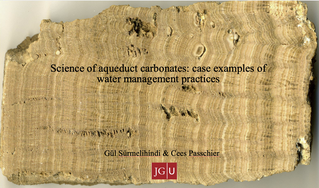
Science of aqueduct carbonates: case examples of water management practices
(Lecture in English)
Dr. Gül Sürmelihindi is a geoarchaeologist and historian of ancient water management practices. She earned her PhD from the University of Mainz under the supervision of Professor Cees Passchier, with whom she assembled the world’s largest collection of anthropogenic carbonate deposits. Following her doctorate, she worked as a researcher at the Max Planck Institute for the History of Science in Berlin. In 2020, she was awarded a Marie Curie fellowship and worked in collaboration with Professor Andrew Wilson as a researcher at the School of Archaeology in Oxford. She is currently working with her team on the use of anthropogenic carbonates as archives of the history of water management, while also studying water systems in the medieval city of Madinat al-Zahra and Roman Cologne.
Gül Sürmelihindi about her lecture:
The study of water management through carbonate deposits in aqueducts is a rapidly growing field of research. Until now, the sources available for interpreting ancient water resource management and sustainable water supply practices have been limited. While archaeological remains and historical records provide a wealth of information, they offer little insight into the operation of aqueducts and hydraulic structures, or into provided water quality and quantity—in short, about the history of the water itself. In this talk, I would like to share with you what we can discover about this subject from anthropogenic carbonates. The cases of Nîmes and Arles will illustrate how aqueducts in use over long periods were modified and restored to meet the changing needs of the population. At Pompeii, we will examine the evolution of hygenic conditions and technological advances in the Republican Baths.
The access data for the online meeting (ZOOM) are as follows:
https://us02web.zoom.us/j/87933930044?pwd=dlk4REZ4S0NnL3k2RGN2TVdtZTd3Zz09
Meeting-ID: 879 3393 0044
Kenncode: 631844
You can download the invitation by clicking the button below.Invitation as pdf
12. November 2026 18:00 o'clock (CET)
Online Lecture Dr. Gül Sürmelihindi & Prof. Cees Passchier – Science of aqueduct carbonates: case examples of water management practices, 12.11.2026
Online lecture
Cordial Invitation
to the Online Lecture (ZOOM) on 12.11.2026, 6:00 pm (CET)
Dr. Gül Sürmelihindi & Prof. Cees Passchier (Universität Mainz)
Science of aqueduct carbonates: case examples of water management practices
(Lecture in English)
Dr. Gül Sürmelihindi is a geoarchaeologist and historian of ancient water management practices. She earned her PhD from the University of Mainz under the supervision of Professor Cees Passchier, with whom she assembled the world’s largest collection of anthropogenic carbonate deposits. Following her doctorate, she worked as a researcher at the Max Planck Institute for the History of Science in Berlin. In 2020, she was awarded a Marie Curie fellowship and worked in collaboration with Professor Andrew Wilson as a researcher at the School of Archaeology in Oxford. She is currently working with her team on the use of anthropogenic carbonates as archives of the history of water management, while also studying water systems in the medieval city of Madinat al-Zahra and Roman Cologne.
Gül Sürmelihindi about her lecture:
The study of water management through carbonate deposits in aqueducts is a rapidly growing field of research. Until now, the sources available for interpreting ancient water resource management and sustainable water supply practices have been limited. While archaeological remains and historical records provide a wealth of information, they offer little insight into the operation of aqueducts and hydraulic structures, or into provided water quality and quantity—in short, about the history of the water itself. In this talk, I would like to share with you what we can discover about this subject from anthropogenic carbonates. The cases of Nîmes and Arles will illustrate how aqueducts in use over long periods were modified and restored to meet the changing needs of the population. At Pompeii, we will examine the evolution of hygenic conditions and technological advances in the Republican Baths.
The access data for the online meeting (ZOOM) are as follows:
https://us02web.zoom.us/j/87933930044?pwd=dlk4REZ4S0NnL3k2RGN2TVdtZTd3Zz09
Meeting-ID: 879 3393 0044
Kenncode: 631844
You can download the invitation by clicking the button below.Invitation as pdf