

Online-Lecture: Thomas Heide (GER) – Wie funktionierten die Thermen Pompejis? Zur Wasserwirtschaft und Technik der städtischen Bäder, 18.06.2026
Cordial Invitation
to the Online Lecture (ZOOM) on 18.06.2026, 6:00 pm (CET)
(Lecture in German)
Thomas Heide, M.A. (Mainz)
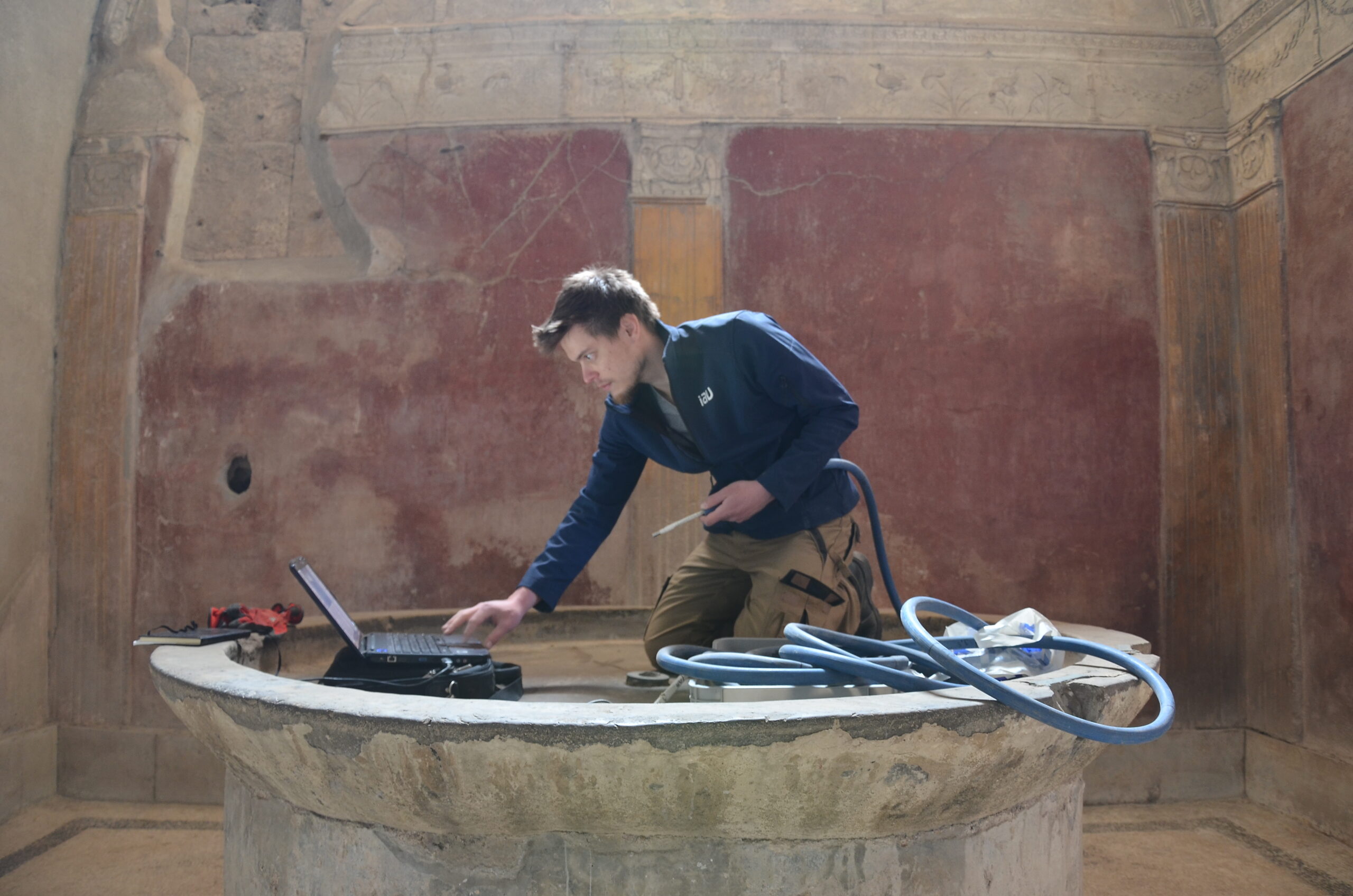
Thomas Heide studied Classics, specialising in Classical Archaeology, at the Free University of Berlin and Oxford. His long-standing involvement in the international project ‘Pompeii: Bathing Culture and the Development of Urban Space’, which has been investigating the Republican and Stabian Baths through several excavation campaigns since 2015, ultimately led to the topic of his doctoral thesis. In addition to bathing culture, Thomas Heide’s research interests lie in the fields of architecture, digital methods and the history of technology. He is currently a research fellow in a 25-year project at the Academy of Sciences and Literature in Mainz, which focuses on the documentation of displaced architectural elements.
Thomas Heide about his lecture:
How did the thermal baths of Pompeii work? On the water management and technology of the city’s baths
Water management was of central importance to ancient thermal baths. Nevertheless, this subject area has so far been inadequately researched. This applies in particular to the large public baths of Pompeii, which, due to their unique state of preservation, lend themselves to in-depth study.
The lecture methodologically combines archaeological, architectural and hydraulic engineering approaches. The Republican Baths, the Stabian Baths and the Forum Baths are examined as case studies to trace the developmental trends regarding bathing practices, architectural design and hydraulic engineering.
Despite individual differences, all three complexes exhibit a comparable pattern of development. In the early phase, the water supply was limited to well systems with restricted flow rates, which allowed only for basic facilities in the hot bathing rooms. A decisive change came with the connection to the municipal long-distance water supply during the Augustan period, which enabled a significant increase in water volumes as well as innovations. The range of bathing facilities was considerably expanded to include cold-water pools, new supply mechanisms and experimental heating systems. Contrary to previous scholarly opinion, the findings also show that the thermal baths were rapidly restored following the earthquake of 62 AD and, in some cases, significantly expanded – for example, with open-air baths and public latrines – which indicates that the water supply system continued to function.
Water management played a key role in the development of Pompeian bathing culture and had a decisive influence on the architectural and functional design of public baths. This confirms not only the adage ‘no water, no baths’, but also the fundamental importance of technical innovation for the further development of the bathing culture.
The access data for the online meeting (ZOOM) are as follows:
https://us02web.zoom.us/j/87933930044?pwd=dlk4REZ4S0NnL3k2RGN2TVdtZTd3Zz09
Meeting-ID: 879 3393 0044; Kenncode: 631844
Online-Lecture: Thomas Heide (GER) – Wie funktionierten die Thermen Pompejis? Zur Wasserwirtschaft und Technik der städtischen Bäder, 18.06.2026
Cordial Invitation
to the Online Lecture (ZOOM) on 18.06.2026, 6:00 pm (CET)
(Lecture in German)
Thomas Heide, M.A. (Mainz)
Thomas Heide studied Classics, specialising in Classical Archaeology, at the Free University of Berlin and Oxford. His long-standing involvement in the international project ‘Pompeii: Bathing Culture and the Development of Urban Space’, which has been investigating the Republican and Stabian Baths through several excavation campaigns since 2015, ultimately led to the topic of his doctoral thesis. In addition to bathing culture, Thomas Heide’s research interests lie in the fields of architecture, digital methods and the history of technology. He is currently a research fellow in a 25-year project at the Academy of Sciences and Literature in Mainz, which focuses on the documentation of displaced architectural elements.
Thomas Heide about his lecture:
How did the thermal baths of Pompeii work? On the water management and technology of the city’s baths
Water management was of central importance to ancient thermal baths. Nevertheless, this subject area has so far been inadequately researched. This applies in particular to the large public baths of Pompeii, which, due to their unique state of preservation, lend themselves to in-depth study.
The lecture methodologically combines archaeological, architectural and hydraulic engineering approaches. The Republican Baths, the Stabian Baths and the Forum Baths are examined as case studies to trace the developmental trends regarding bathing practices, architectural design and hydraulic engineering.
Despite individual differences, all three complexes exhibit a comparable pattern of development. In the early phase, the water supply was limited to well systems with restricted flow rates, which allowed only for basic facilities in the hot bathing rooms. A decisive change came with the connection to the municipal long-distance water supply during the Augustan period, which enabled a significant increase in water volumes as well as innovations. The range of bathing facilities was considerably expanded to include cold-water pools, new supply mechanisms and experimental heating systems. Contrary to previous scholarly opinion, the findings also show that the thermal baths were rapidly restored following the earthquake of 62 AD and, in some cases, significantly expanded – for example, with open-air baths and public latrines – which indicates that the water supply system continued to function.
Water management played a key role in the development of Pompeian bathing culture and had a decisive influence on the architectural and functional design of public baths. This confirms not only the adage ‘no water, no baths’, but also the fundamental importance of technical innovation for the further development of the bathing culture.
The access data for the online meeting (ZOOM) are as follows:
https://us02web.zoom.us/j/87933930044?pwd=dlk4REZ4S0NnL3k2RGN2TVdtZTd3Zz09
Meeting-ID: 879 3393 0044; Kenncode: 631844