

9. April 2026 18:00 Uhr (MEZ)
Online Lecture Fernando Aranda Guiterrez (ES) – The Roman Water Supply Systems to Augusta Emerita
Online lecture
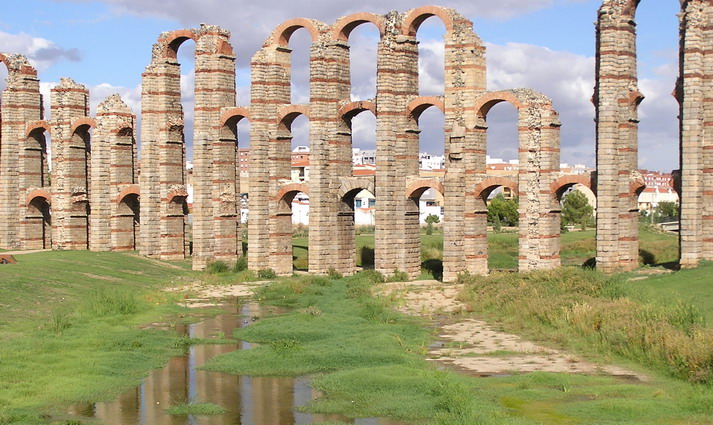
Los Milagros Aquedukt
Cordial Invitation
to the Online Lecture (ZOOM)
on 09.04.2026, 6:00 pm (CET)
Fernando Aranda Gutierrez, Merida, Spain
The Roman Water Supply Systems to Augusta Emerita
(Lecture in English)
Fernando Aranda Gutierrez is a civil engineer and currently the Technical Director of “Confederación Hidrográfica del Guadiana” (Spanish water administration on Guadiana river basin). He was chief engineer of the Roman-origin dams of Proserpina and Cornalbo for over fifteen years (both dams are still in use, managed by Confederación Hidrográfica del Guadiana). And therefore, has led major restoration projects of these dams, specially Proserpina dam. Author of several papers and publications about the Roman water supply systems, especially focused on the role of dams and reservoirs on these systems.
Fernando Aranda Gutierrez about his lecture:
The ancient city of Emerita Augusta (currently Mérida) was a very important city in the Roman province of Lusitania in Hispania. The population has been estimated between 30,000 and 50,000 people; therefore an appropriate water supply was needed.
However, the environmental conditions (climatologic, hydrologic and geologic) in the zone cause that finding water is not easy at any time. The average rainfall is about 500 mm per year, but it presents a great irregularity, and potential evapotranspiration is very high, about 1,200 mm per year, due to the long and hot summer. Further on, the geological structures of the area are mainly constituted of impermeable rocks (granit, cuarcite, slate…), so there is little storage of water in the ground, thus there are not abundant springs. The flow of streams and rivers is very irregular, and they usually get dry in the summer.
So to obtain the water they needed, a great effort had to be done. Three hydraulic systems have been constructed, parts of which are still in use today. To capture the water, two different fittings have been constructed, underground tunnels or “qanats” below the streams, and the dams with their reservoirs.
The first system built was the “Aqua Augusta” now known as “Cornalbo system”, initially just with qanats, and later with a reservoir added created by “Cornalbo” dam. The second system was “Rabo de Buey-San Lázaro”, which obtains water from qanats. And the third was the “Proserpina” system, which uses the water of the reservoir created by the “Proserpina” dam.
Recently, remains of what could have been another water conduction, coming from a stream, have been found, the so called “Fourth aqueduct”, but it is still unclear, as the remains are very scarce.
Both dams, and some of the qanats, are still in use today. At all, the romans used about 100 km2 of hidrological basins surface, 15 km of qanats, two big dams, 30 km of conductions, two monumental “bridge-aqueducts” (Los Milagros and San Lázaro), and several smaller ones, to get an estimated flow of 105 liters per second into the city.
The access data for the online meeting (ZOOM) are as follow
https://us02web.zoom.us/j/87933930044?pwd=dlk4REZ4S0NnL3k2RGN2TVdtZTd3Zz09
Meeting-ID: 879 3393 0044
Kenncode: 631844
The invitation to this online lecture as a document you can download by using the button below.
9. April 2026 18:00 o'clock (CET)
Online Lecture Fernando Aranda Guiterrez (ES) – The Roman Water Supply Systems to Augusta Emerita
Online lecture
Los Milagros Aquedukt
Cordial Invitation
to the Online Lecture (ZOOM)
on 09.04.2026, 6:00 pm (CET)
Fernando Aranda Gutierrez, Merida, Spain
The Roman Water Supply Systems to Augusta Emerita
(Lecture in English)
Fernando Aranda Gutierrez is a civil engineer and currently the Technical Director of “Confederación Hidrográfica del Guadiana” (Spanish water administration on Guadiana river basin). He was chief engineer of the Roman-origin dams of Proserpina and Cornalbo for over fifteen years (both dams are still in use, managed by Confederación Hidrográfica del Guadiana). And therefore, has led major restoration projects of these dams, specially Proserpina dam. Author of several papers and publications about the Roman water supply systems, especially focused on the role of dams and reservoirs on these systems.
Fernando Aranda Gutierrez about his lecture:
The ancient city of Emerita Augusta (currently Mérida) was a very important city in the Roman province of Lusitania in Hispania. The population has been estimated between 30,000 and 50,000 people; therefore an appropriate water supply was needed.
However, the environmental conditions (climatologic, hydrologic and geologic) in the zone cause that finding water is not easy at any time. The average rainfall is about 500 mm per year, but it presents a great irregularity, and potential evapotranspiration is very high, about 1,200 mm per year, due to the long and hot summer. Further on, the geological structures of the area are mainly constituted of impermeable rocks (granit, cuarcite, slate…), so there is little storage of water in the ground, thus there are not abundant springs. The flow of streams and rivers is very irregular, and they usually get dry in the summer.
So to obtain the water they needed, a great effort had to be done. Three hydraulic systems have been constructed, parts of which are still in use today. To capture the water, two different fittings have been constructed, underground tunnels or “qanats” below the streams, and the dams with their reservoirs.
The first system built was the “Aqua Augusta” now known as “Cornalbo system”, initially just with qanats, and later with a reservoir added created by “Cornalbo” dam. The second system was “Rabo de Buey-San Lázaro”, which obtains water from qanats. And the third was the “Proserpina” system, which uses the water of the reservoir created by the “Proserpina” dam.
Recently, remains of what could have been another water conduction, coming from a stream, have been found, the so called “Fourth aqueduct”, but it is still unclear, as the remains are very scarce.
Both dams, and some of the qanats, are still in use today. At all, the romans used about 100 km2 of hidrological basins surface, 15 km of qanats, two big dams, 30 km of conductions, two monumental “bridge-aqueducts” (Los Milagros and San Lázaro), and several smaller ones, to get an estimated flow of 105 liters per second into the city.
The access data for the online meeting (ZOOM) are as follow
https://us02web.zoom.us/j/87933930044?pwd=dlk4REZ4S0NnL3k2RGN2TVdtZTd3Zz09
Meeting-ID: 879 3393 0044
Kenncode: 631844
The invitation to this online lecture as a document you can download by using the button below.