

Publications
One of the aims of the Frontinus Society is to publish the research findings of its members and other scholars. To this end, the following publication series exist:
This publication series presents the activities of the association for the members.
Registration via our website is required for access.
Already registered?
The Frontinus Society’s series has been published since 1978. It now comprises 34 volumes, the contents of which are presented in tabular form.
The list of previously published issues of the Frontinus series can be downloaded as a PDF file below.

The Frontinus series can be purchased at the prices listed below:
| Volume 1 (copy) | 1,00 € |
| Volume 2-7 | 1,00 € |
| Volume 8-10 | sold out |
| Volume 11-12 | 1,00 € |
| Volume 13 | not available here *) |
| Volume 14 | sold out |
| Volume 15-23 | 1,00 € |
| Volume 24 | 5,00 € |
| Volume 25 | 5,00 € |
| Volume 26 | 10,00 € only as pdf-file |
| Volume 27 | 10,00 € only as pdf-file |
| Volume 28 | 10,00 € |
| Volume 29 | 15,00 €, 10,00 € for members |
| Volume 30 | 15,00 €, 10,00 € for members |
| Volume 31 | 15,00 €, 10,00 € for members |
| Volume 32 | 25,00 €, 20,00 € for members |
| Volume 33 | 25,00 €, 20,00 € for members |
| Volume 34 | 25,00 €, 20,00 € for members |
*) Volume 13: New edition of Harzwasserwerke at Grosse’sche Buchhandlung, 38678 Clausthal-Zellerfeld, E-Mail: bu**@*********rz.de , Tel 05323 9390-0
All prices plus shipping costs
Student members and members under 25 years of age can receive the books free of charge as pdf-files at the office (Contact) (if available).
The books in the book series „History of Water Supply“ deal thematically with a single aspect of the history of water supply in several chapters or in several technical articles. Of this book series, 7 books have been published so far, among others volume 1 „Water supply in ancient Rome“ with the original Latin text of Frontinus, a German translation and some technical essays on this topic.
Volume 1: Die Wasserversorgung im antiken Rom
Completely revised edition 2013
ISBN: 978-3-8356-7107-2
Book series „History of water supply“ – Volume 1

Volume 7: Wasser auf Burgen im Mittelalter
Book series „History of water supply“ – Band 7
Volume 7: Wasser auf Burgen im Mittelalter
2007
ISBN: 978-3-8053-3762-5
Book series „History of water supply“ – Volume 7
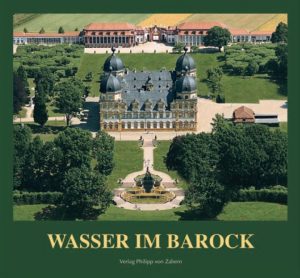
Volume 6: Wasser im Barock
Book series „History of water supply“ – Band 6
Volume 6: Wasser im Barock
2004
ISBN: 3-8053-3331-5
Book series „History of water supply“ – Volume 6

Volume 5: Die Wasserversorgung in der Renaissancezeit
Book series „History of water supply“ – Band 5
Volume 5: Die Wasserversorgung in der Renaissancezeit
2000
ISBN: 3-8053-2700-5
Book series „History of water supply“ – Volume 5
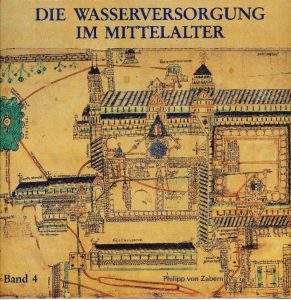
Volume 4: Die Wasserversorgung im Mittelalter
Book series „History of water supply“ – Band 4
Volume 4: Die Wasserversorgung im Mittelalter
1991
ISBN: 3-8053-1157-5
Book series „History of water supply“ – Volume 4
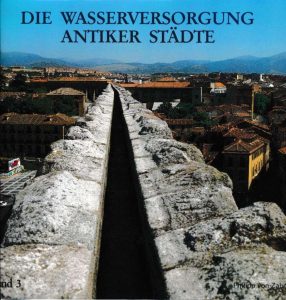
Volume 3: Die Wasserversorgung antiker Städte, Part 2
Book series „History of water supply“ – Band 3
Volume 3: Die Wasserversorgung antiker Städte, Part 2
1988
ISBN: 3-8053-0984-8
Book series „History of water supply“ – Volume 3

Volume 2: Die Wasserversorgung antiker Städte Part 1
Book series „History of water supply“ – Band 2
Volume 2: Die Wasserversorgung antiker Städte Part 1
1987
ISBN: 3-8053-0933-3
Book series „History of water supply“ – Volume 2
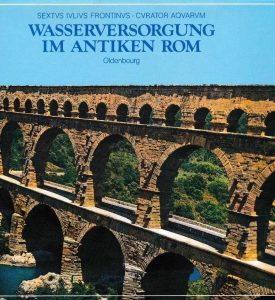
Volume 1: Die Wasserversorgung im antiken Rom (First edition 1981)
Book series „History of water supply“ – Band 1
Volume 1: Die Wasserversorgung im antiken Rom (First edition 1981)
1981
ISBN: 3-486-26112-6
Book series „History of water supply“ – Volume 1
The books presented here by individual authors deal with more narrowly defined topics on ancient or historical water catchment, use and presentation, including the associated cultural, social, artistic and constructional aspects as well as the geographical and climatic environment.
Three monographs were published as Frontinus supplements by 2001. In addition to these, we present Klaus Grewe’s “Technological History Travel Guides” here.
If not out of print, the books are available from the Frontinus Society office or from bookstores.
Out-of-print volumes are often still available in antiquarian bookshops (e.g. via www.zvab.com – ZVAB – Zentrales Verzeichnis Antiquarischer Bücher).

Planning and routing of Roman aqueducts
Klaus Grewe
Frontinus Supplement – Band 1
Planning and routing of Roman aqueducts
Klaus Grewe
Frontinus Supplement – Volume 1

Mohenjo-Daro
Michael Jansen
Frontinus Supplement – Band 2
Mohenjo-Daro
Michael Jansen
Frontinus Supplement – Volume 2

Water in the Holy Land
Wiel Dierx and Günther Garbrecht
Frontinus Supplement – Band 3
Water in the Holy Land
Wiel Dierx and Günther Garbrecht
Frontinus Supplement – Volume 3

Great Britain: England – Scotland – Wales
Klaus Grewe
Frontinus Travelbooks
Great Britain: England – Scotland – Wales
Klaus Grewe
Frontinus Travelbooks

Denmark
Klaus Grewe
Frontinus Travelbooks
Denmark
Klaus Grewe
Frontinus Travelbooks
BABESCH – Annual Papers on Mediterranean Archaeology – formerly Bulletin Antieke Beschaving – is the publication organ of the Dutch BABESCH Foundation, published by the Belgian Peeters Verlag, Leuven. Several BABESCH supplementary volumes also cover the archaeological spectrum of the Frontinus Society.
Since 1994/96, publications of archaeological conferences in which the Frontinus Society was involved or was the organiser have appeared as BABESCH Supplementary Volumes. In addition, central book publications of the Frontinus-Society are also published in the series of Babesch-Supplement-Bände.
These publications are available to members at special rates from the Frontinus office in addition to the Peeters publishing house. In this section you will also find other BABESCH-Supplement publications on ancient water culture, which can be obtained from bookstores or from Peeters publishing house.

Bathing Culture in Budapest
G. Wiplinger – Frontinus Society
Babesch volumes – Band 50
Bathing Culture in Budapest
G. Wiplinger – Frontinus Society
Babesch volumes – Volume 50

Sixty-six toilets and urinals in the ancient city of Rome
Jansen, G.C.M., Koloski-Ostrow, A.O., Neudecker R.
Babesch volumes – Band 48
Sixty-six toilets and urinals in the ancient city of Rome
Jansen, G.C.M., Koloski-Ostrow, A.O., Neudecker R.
Babesch volumes – Volume 48

De Aquaeductu Urbis Romae – Sextus Iulius Frontinus and the water of Rome
Wiplinger, G. – Frontinus-Gesellschaft
Babesch volumes – Band 40
De Aquaeductu Urbis Romae – Sextus Iulius Frontinus and the water of Rome
Wiplinger, G. – Frontinus-Gesellschaft
Babesch volumes – Volume 40

The Degimendere Aqueduct of Ephesus Parts 1 and 2
Wiplinger, G.
Babesch volumes – Band 36
The Degimendere Aqueduct of Ephesus Parts 1 and 2
Wiplinger, G.
Babesch volumes – Volume 36

Water engineering at the time of Frontinus – Buildings – Technology – Culture
Letzner W., Wiplinger G. – Frontinus Society
Babesch volumes – Band 32
Water engineering at the time of Frontinus – Buildings – Technology – Culture
Letzner W., Wiplinger G. – Frontinus Society
Babesch volumes – Volume 32

De Aquaeductu Atque Aqua Urbium Lyciae Pamphyliae Pisidiae
Wiplinger G., Frontinus Society – ÖAI / ÖAW
Babesch volumes – Band 27
De Aquaeductu Atque Aqua Urbium Lyciae Pamphyliae Pisidiae
Wiplinger G., Frontinus Society – ÖAI / ÖAW
Babesch volumes – Volume 27

Historic water pipes
Wiplinger G., Frontinus-Gesellschaft e.V. – ÖAI
Babesch volumes – Band 24
Historic water pipes
Wiplinger G., Frontinus-Gesellschaft e.V. – ÖAI
Babesch volumes – Volume 24

Greek Baths and Bathing Culture
Lucore S. K., Trümper M.
Babesch volumes – Band 23
Greek Baths and Bathing Culture
Lucore S. K., Trümper M.
Babesch volumes – Volume 23

SPA – Sanitas per Aquam
Kreiner R., Letzner W., Frontinus Society
Babesch volumes – Band 21
SPA – Sanitas per Aquam
Kreiner R., Letzner W., Frontinus Society
Babesch volumes – Volume 21

Roman Toilets
Jansen G.C.M., Koloski-Ostrow A.O., Moormann E.M.
Babesch volumes – Band 19
Roman Toilets
Jansen G.C.M., Koloski-Ostrow A.O., Moormann E.M.
Babesch volumes – Volume 19

Dulcissima Aequora
Manderscheid H.
Babesch volumes – Band 13
Dulcissima Aequora
Manderscheid H.
Babesch volumes – Volume 13

Cura Aquarum in Ephesus Volume I & II
Wiplinger G., ÖAI
Babesch volumes – Band 12
Cura Aquarum in Ephesus Volume I & II
Wiplinger G., ÖAI
Babesch volumes – Volume 12

Cura Aquarum in Sicilia
Jansen G.C.M.
Babesch volumes – Band 6
Cura Aquarum in Sicilia
Jansen G.C.M.
Babesch volumes – Volume 6

Cura Aquarum in Campania
de Haan N., Jansen G.C.M.
Babesch volumes – Band 4
Cura Aquarum in Campania
de Haan N., Jansen G.C.M.
Babesch volumes – Volume 4
Here you will find publications on the history of water and energy supply as well as on ancient water economy, water supply, construction and water technology.
Annual Bibliography 2022-2023
Annual Bibliography 2020-2021
Annual Bibliography 2018-2019
Annual Bibliography 2017
Annual Bibliography 2016
Annual Bibliography 2015
Annual Bibliography 2014
Annual Bibliography 2013
Annual Bibliography 2007-2012
Annual Bibliography 2006
Annual Bibliography 2005
Annual Bibliography 2004
We refer to monographs published by members of the Frontinus Society.
Water for Hadrian´s Villa
Jørgen Hansen
Monographs
Water for Hadrian´s Villa
A Survey for the Water Supply to the Imperial Villa
Jørgen Hansen
Everything you always wanted to know about Roman engineers
Klaus Grewe
Monographs
Everything you always wanted to know about Roman engineers
50 questions and 50 answers about ancient technology
Klaus Grewe
Aqueducts
Klaus Grewe
Monographs
Aqueducts
Water for Rome’s cities
Klaus Grewe

NIL MAGIS MIRANDUM IN TOTO ORBE TERRARUM
Hubertus Manderscheid
Monographs
NIL MAGIS MIRANDUM IN TOTO ORBE TERRARUM
Water management, hydrotechnics and water architecture of Minturnae
Hubertus Manderscheid

The Cistercians and the water
Ulrich Knapp
Monographs
The Cistercians and the water
with special reference to the abbeys of Bebenhausen, Maulbronn and Salem
Ulrich Knapp
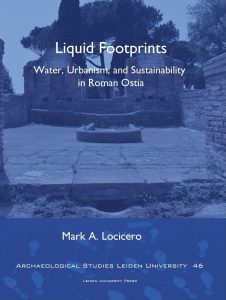
Liquid Footprints
Mark A. Locicero
Monographs
Liquid Footprints
Water, Urbanism and Sustainability in Roman Ostia
Mark A. Locicero

The gas tank as a construction type
Barbara Berger
Monographs
The gas tank as a construction type
The history of building construction in the 19th and early 20th centuries. Developed in England, optimized in Germany, and spread worldwide – illustrated by the example of Italy.
Barbara Berger

Water towers in Saxony
Jens U. Schmidt, Andreas Rudolph, Matthias Röthke and Jens Jeschke
Monographs
Water towers in Saxony
Jens U. Schmidt, Andreas Rudolph, Matthias Röthke and Jens Jeschke
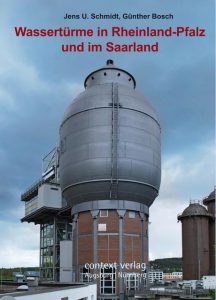
Water towers in Rhineland-Palatinate and Saarland
Jens U. Schmidt, Günther Bosch
Monographs
Water towers in Rhineland-Palatinate and Saarland
Jens U. Schmidt, Günther Bosch
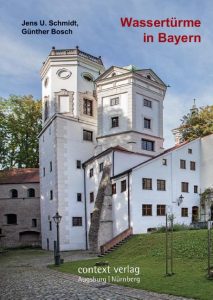
Water towers in Bayern
Jens U. Schmidt und Günther Bosch
Monographs
Water towers in Bayern
Jens U. Schmidt und Günther Bosch

Water towers in Bremen and Hamburg
Jens U. Schmidt
Monographs
Water towers in Bremen and Hamburg
Jens U. Schmidt

Water towers in Berlin
Jens U. Schmidt
Monographs
Water towers in Berlin
Jens U. Schmidt
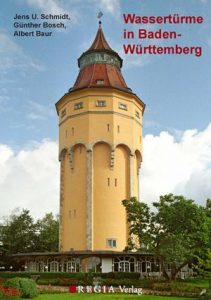
Water towers in Baden-Württemberg
Jens U. Schmidt, Günther Bosch and Albert Baur
Monographs
Water towers in Baden-Württemberg
Jens U. Schmidt, Günther Bosch and Albert Baur

Water towers in Schleswig-Holstein
Jens U. Schmidt
Monographs
Water towers in Schleswig-Holstein
Jens U. Schmidt

Water towers in the northwest
Nils Aschenbeck und Jens U. Schmidt
Monographs
Water towers in the northwest
Nils Aschenbeck und Jens U. Schmidt
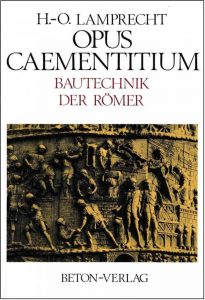
OPUS CAEMENTITIUM
Heinz-Otto Lamprecht
Monographs
OPUS CAEMENTITIUM
Roman construction technology
Heinz-Otto Lamprecht

Light at the end of the tunnel
Klaus Grewe
Monographs
Light at the end of the tunnel
Planning and routing in ancient tunnel construction
Klaus Grewe
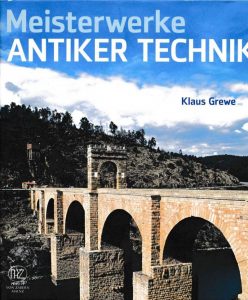
Masterpieces of ancient technology
Klaus Grewe
Monographs
Masterpieces of ancient technology
Klaus Grewe
Water heritage
Historical fountains in Saxony
Von: Hans-Jürgen Voigt et. al.
(2025)
Our member Prof. Dr. Hans-Jürgen Voigt, together with Prof. Dr.-Ing. Horst Wingrich and Dipl.-Ing. (FH) Michael Zajontz, has published a publication entitled “Water Heritage – Historical Wells in Saxony.” It is a comprehensive overview of wells and springs of various types and uses in Saxony.
A total of 225 pages describe a variety of wells and springs in terms of their technical design, use, and (cultural) historical background. The descriptions are often enriched with regional and local history information.
We would like to recommend reading this publication to anyone who has a personal connection to Saxony and is interested in water management.
Baiae and the symbolism of ancient thermal architecture
Von: Werner Heinz
(2025)
Our member Dr. Werner Heinz has published a paper on the topic of “Baiae and the Symbolism of Ancient Thermal Bath Architecture.” We recommend reading this paper as a prelude to the Frontinus excursion to southern Baden-Württemberg (“Thermentour”) from September 8–11, 2025.
Thermal baths and baths are among the most numerous and diverse structures left behind by the Romans. They can be found in Rome, in the heartland of Italy, and in the provinces, both in public spaces and in private living areas. Some of the massive imperial thermal baths dominate the cityscape of Rome and other ancient cities to this day. It is worthwhile to examine the symbolic significance of this architectural genre.
The Ancient Water System of Sepphoris
The Arched Reservoirs
Von: Tsvika Tsuk
(2024)
The thermal baths: wellness centers from Roman times
Von: Giovanni Polizzi
(2025)
The practice of thermal bathing is a characteristic feature of Roman culture, so much so that buildings associated with the thermal baths were an essential element in all cities of the empire, especially in the newly founded ones. Wherever they went, Roman settlers brought with them several elements of their culture, and the practice of bathing was a must.
Many of the Roman provincial cities had abundant mineral or natural springs. For example, in the cities of Aix-en-Provence and Aix-les-Bains in France, Baden-Baden in Germany, and Bath in England. In all cases, these were cities whose place names already indicate the presence of baths. These were fed by natural thermal water or artificially heated water from specially constructed hydraulic infrastructures (large reservoirs or aqueducts).
Roman bathing culture is the further development of bathing practices already known in the Greek world. The first public baths spread in Rome as early as the 3rd century BC.
Solunto and the water
The use of water resources in the ancient city of Solunto
Von: Giovanni Polizzi
(2025)
This paper examines water management in the ancient city of Solunto and the solutions adopted by its inhabitants regarding its hydraulic structures. It fills a gap in our knowledge of the city’s water management, a topic long neglected by modern research.
In terms of historical and geographical context, the Punic city of Solunto was founded on Monte Catalfano in Sicily in the 4th century BC. Archaeological finds show that this city was inhabited until the 3rd century AD, when it experienced a period of decline that culminated in its abandonment.
Mapping river gods
Highlighting the importance of rivers as gods, as seen through their representations in art during the Roman period in the regions of Macedonia and Thrace
Von: Georgia Aristodemou
(2025)
The personification of local bodies of water (rivers or lakes) and their worship as deities was widespread in the Greek and Roman worlds. Homer (Iliad 21. 195) considers rivers to be gods and reports that Oceanus is the source of all rivers, all springs, and all fountains in the universe. Hesiod (Theogony 337-370) also tells us that all rivers originate from Oceanus and Tethys. Already in Homeric poems, rivers in human form were considered immortal, divine figures, and temples or altars were built to them, some even with their own priests. Hesiod (Erga kai Emerai 737-741) reports that a person who had to cross a river had to offer a sacrifice to the river and wash their hands. In this context, the river gods were often among the deities invoked in various oaths.
How did the “outrageously” short construction times for major Roman projects come about?
Von: Klaus Grewe
(2021)
Roman engineers were not only outstanding in the construction of impressive structures, such as the monumental aqueducts that supplied the population with fresh drinking water. They also completed these structures in extremely short construction times. Our board member Klaus Grewe has written an interesting article on this topic that we recommend for reading.
How did the »outrageously« short construction times for major Roman projects come about?
The Roman architects set new standards not only with ingenious designs for their time (semicircular arches in bridge construction, dome structures), but also with the development of particularly strong and durable building materials. In particular, construction work was already at a level comparable to today’s standards. For example, in order to reduce construction times in aqueducts, construction was already carried out in sections. This was confirmed by the investigations into the Eifel Aqueduct. For example, between the individual sections, drops and small stilling basins were found (see image) to overcome the resulting slight differences in height in the canal bed, thus confirming such a division into sections.
The article was published in VDVmagazin 6/21.
De trigono balistario – The ballista triangle
Technical chapters and selected applications
Von: Johannes Fontana, edited by Horst Kranz
(January 2021)
Surveying plays a crucial role in the construction of water pipes, from ancient aqueducts to modern pipeline systems.
Johannes Fontana of Venice was practicing medicine in Udine when he wrote the extensive treatise “De trigono balistario” in 1440. The innovative ballista triangle combined the functions of several measuring instruments. Depending on its configuration, the instrument was suitable for terrestrial or astronomical measurements. This publication contains instructions for construction and application and is available in the original Latin version and a German translation. Text, translation, and drawings by Horst Kranz
We recommend reading this text, which is both technically and historically very interesting, to all interested persons.
Roman bathing in Coriovallum
Von: K. Jeneson and W.K. Vos (eds.)
(2019)
This report provides an integrated, comprehensive academic study of one of the most important archaeological monuments in the Netherlands: the Roman bath complex in Heerlen. This provides us with thorough and detailed knowledge of the building, development, nature, and use of the monumental bath complex, which for centuries was a center of the municipality of Coriovallum, present-day Heerlen.
Coriovallum was built at the intersection of two important Roman roads. The first, known today as the Via Belgica, connected the border region along the Rhine with the hinterland in Gaul; the second ran from Aquae Granni (Aachen) in the south, along the right bank of the Meuse, to the large legionary camp of the Vetera in Xanten in the north. Coriovallum was thus directly connected to the two coloniae that later emerged on the Rhine: Colonia Claudia Ara Agrippinensium (Cologne) and Colonia Ulpia Traiana (Xanten). It can therefore be assumed that this bathhouse possessed supra-regional importance.
Further information about these studies can be found on the website of the Thermenmuseum Heerlen.
Recent Developments in Aqueduct Research
Von: Klaus Grewe
(2019)
Our board member Prof. Dr. Klaus Grewe has published a very interesting article entitled “Recent Developments in Aqueduct Research” in the Mouseion supplement series of the University of Toronto, which we would like to draw your attention to.
The water supply of Ephesus in Byzantine times
Von: Dipl. Ing. Gilbert Wiplinger
(2010)
Article by our board member, Dipl. Ing. Gilbert Wiplinger, in “Byzantium – the Roman Empire in the Middle Ages, Part 2,2,” published by the Roman-Germanic Central Museum in 2010.
On the trail of water supply
Von: Wolfgang Merkel
(2006)
Lecture by our board member Prof. Dr.-Ing. Wolfgang Merkel at the symposium 130 Years of Central Water Supply Erfurt, organized by ThüWa Thüringen Wasser GmbH, the BGW/DVGW regional groups East, and the Frontinus Society in Erfurt on June 7, 2006.
New excavation finds from Weimar’s water supply
Von: Prof. Dr.-Ing. habil. Harald Roscher.
(2006)
Sextus Iulius Frontinus, princeps vir
Von: Karl Christ
(1989)
Sextus Julius Frontinus was a multi-talented figure in the Roman Empire from the 1st to the beginning of the 2nd century. Karl Christ (1923–2008), one of the leading ancient historians of his time, paints a picture of Frontinus’s personality in a publication. According to his work, Frontinus was not only an extremely gifted administrator, general, and engineer, but also distinguished himself by his great objectivity, vision, modesty, and loyalty. He was thus one of the most important figures in the Roman Empire.
We recommend that you read this publication.
Dresdner Technikhistorie
Pages on the water history of Dresden
Von: WIMAD, Verein für Wissenschaftler und ingenieurtechnische Mitarbeiter Dresden e.V. & Frontinus-Gesellschaft e.V.
(October 2006)
As part of the Frontinus excursion to Dresden from October 8-10, 2006, in cooperation with WIMAD, the Dresden Association for Scientists and Engineering Staff, facilities and finds from the historical water supply of Dresden and the surrounding area were presented and inspected. They are presented below as WIMAD’s “Pages on Dresden’s Water History.”
1. Frontin Konkordanz
Our member Manfred Hainzmann has created an online database based on the edition by W. Letzner and W. Merkel in the book “The Water Supply in Ancient Rome” (Volume 1 of the Frontinus book series “History of Water Supply”), which provides access to the full vocabulary of this unique specialist text by Frontinus, while simultaneously highlighting all differing readings compared to four other editions:
- Frontin. Les aqueducs de la ville de Rome, ed. P. Grimal, Paris (2nd Edition) 1961.
- Sex. Iulius Frontinus, De aquaeductu urbis Romae, ed. C. Kunderewicz, Leipzig 1973
- Frontino. De aquae ductu urbis Romae, ed. F. del Chicca, Roma 2004
- Frontinus: de aquaeductu urbis Romae, ed. R. H. Rodgers, Cambridge 2004.
1. ANCIENT WRITTEN EVIDENCE on Roman Water Management
Our member Manfred Hainzmann has agreed to present Latin texts that are particularly valuable for understanding Roman water management. The editorial focus is on both variant readings (variae lectiones) in the reviewed editions and the presentation of the text in both majuscule and minuscule script. Concordances and word indexes are intended to stimulate further historical, epigraphic, and philological studies.
- Edictum Augusti de aquaeducto Venafrano (EVen)